
Modelling sky luminance#
In this tutorial, we will show how astk can be used to model sky luminance, that is how to input natural light conditions for simulating light interception
[1]:
from openalea.astk.sky_map import sky_grid, sky_map, show_sky
from openalea.astk.sky_sources import sky_turtle
from openalea.astk.sky_luminance import sky_luminance
from openalea.astk.sky_irradiance import sky_irradiance
Estimate sky irradiance#
By default , astk simulate one day long clear sky irradiance at Montpellier, the 21 of June 2000. For computing sky irradiance at your location or for longer/shorter perido of time, see ‘Modeling sky irradiance’ companion tutorial
[2]:
sky_irr = sky_irradiance()
sky_irr
[2]:
| azimuth | zenith | elevation | ghi | dni | dhi | ppfd | |
|---|---|---|---|---|---|---|---|
| 2000-06-21 07:00:00+02:00 | 64.964943 | 82.113168 | 7.886832 | 60.946465 | 92.041199 | 48.316857 | 148.294639 |
| 2000-06-21 08:00:00+02:00 | 74.426178 | 71.957421 | 18.042579 | 229.864545 | 453.118711 | 89.522953 | 504.948469 |
| 2000-06-21 09:00:00+02:00 | 83.866975 | 61.281260 | 28.718740 | 416.105120 | 671.771159 | 93.312118 | 873.937767 |
| 2000-06-21 10:00:00+02:00 | 94.061489 | 50.403526 | 39.596474 | 591.750512 | 751.066148 | 113.038550 | 1212.231017 |
| 2000-06-21 11:00:00+02:00 | 106.318067 | 39.689358 | 50.310642 | 741.184658 | 782.891568 | 138.735360 | 1496.174934 |
| 2000-06-21 12:00:00+02:00 | 123.250892 | 29.785355 | 60.214645 | 852.932174 | 778.469936 | 177.303988 | 1707.180678 |
| 2000-06-21 13:00:00+02:00 | 149.893038 | 22.213724 | 67.786276 | 918.828032 | 787.889552 | 189.415600 | 1831.279539 |
| 2000-06-21 14:00:00+02:00 | 188.216321 | 20.077412 | 69.922588 | 934.150316 | 785.467446 | 196.415993 | 1860.110781 |
| 2000-06-21 15:00:00+02:00 | 222.570039 | 24.861968 | 65.138032 | 897.808460 | 790.895864 | 180.210219 | 1791.714236 |
| 2000-06-21 16:00:00+02:00 | 244.497975 | 33.670653 | 56.329347 | 812.392859 | 781.474663 | 162.019789 | 1630.727935 |
| 2000-06-21 17:00:00+02:00 | 259.065446 | 44.019757 | 45.980243 | 684.060062 | 764.123266 | 134.578851 | 1387.926414 |
| 2000-06-21 18:00:00+02:00 | 270.262468 | 54.855468 | 35.144532 | 522.326049 | 715.011297 | 110.736258 | 1079.269004 |
| 2000-06-21 19:00:00+02:00 | 280.031698 | 65.688728 | 24.311272 | 340.124868 | 575.665050 | 103.127220 | 725.138994 |
| 2000-06-21 20:00:00+02:00 | 289.403843 | 76.194198 | 13.805802 | 156.015935 | 290.498008 | 86.693873 | 353.173644 |
| 2000-06-21 21:00:00+02:00 | 299.040349 | 86.002561 | 3.997439 | 14.846194 | 0.000000 | 14.846194 | 40.029084 |
Estimate sky relative luminance#
Sky luminance is estimated from sky irradiances, using Perez all weather sky model (R. Perez, R. Seals, J. Michalsky, “All-weather model for sky luminance distribution—Preliminary configuration and validation”, Solar Energy, Volume 50, Issue 3, 1993, Pages 235-245)
Luminance is computed every steradian of the sky hemisphere
Luminance are scaled to ensure a global horizontal irradiance of 1
[3]:
grid=sky_grid()
sun, sky=sky_luminance(grid, 'all_weather', sky_irr)
[4]:
show_sky(grid, sky)

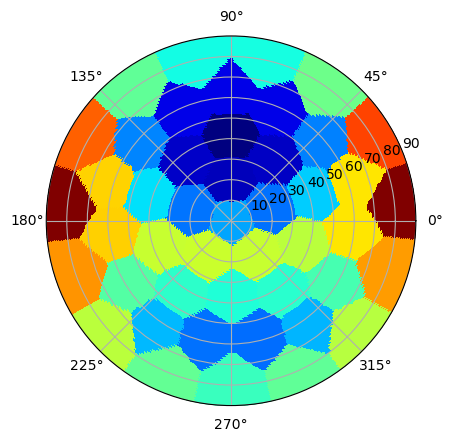
Define sky discretisation#
Sky discretisation allow to split the sky in a limited number of direction for efficiency of light modelling.
other strategies can be found in the companon tutorial
[5]:
disc = sky_turtle()
sky_agg, grid_agg, sky_disc = sky_map(grid, sky, disc)
show_sky(grid,sky_disc)
[ ]:
[ ]: